Agentica Agents - Smart AI Agents
Smart AI Agents that can achieve tasks automatically, either designed specifically or designed to adapt over time. Agentica Smart AI Agents to automate many mundane tasks is coming soon!
Smart AI Agents that can achieve tasks automatically, either designed specifically or designed to adapt over time. Agentica Smart AI Agents to automate many mundane tasks is coming soon!
Today, Agents running AI in smart ways, is very powerful! We have been working on Agentica for some time, correcting, perfecting, and getting it to that stage, where it can easily compete with other world leading Agent Swarms like AgentZero, Open Claw and others!
Download and evaluate Agentic today: https://github.com/OzzieAI-AU/Agentica
How Agentica works:
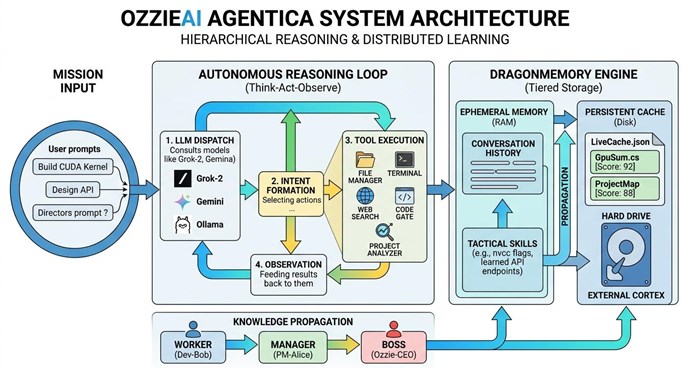
OzzieAI Agentica: Architectural Overview
OzzieAI Agentica is a biological analog for artificial intelligence, functioning as a digital organism with a nervous system (the Bus), a brain (the LLM), hands (Tools), and a multi-layered memory system (DragonMemory & LiveCache)[cite: 1]. It is designed as a hierarchical swarm where independent "brains" function as a unified entity[cite: 17].
I. The Macro-Architecture (The "Unison" Swarm)
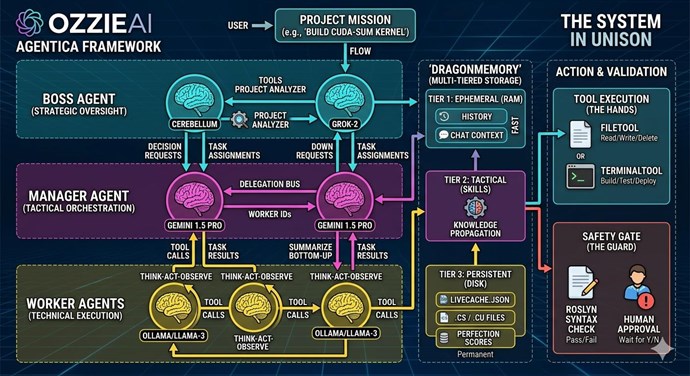
Agentica is structured as a hierarchical swarm rather than a single chatbot[cite: 2, 3]. This "Unison" protocol utilizes a clear chain of command:
The Hierarchy
* The Boss: Provides the vision and high-dimensional reasoning for strategic planning[cite: 3, 42].
* The Manager: Provides tactics and project analysis[cite: 3, 45].
* The Worker: Executes specific tasks, such as code generation and terminal actions[cite: 3, 43, 45].
Each agent is an independent entity with its own dedicated LLM Provider and specific toolset[cite: 4]. This decoupled design ensures that if one agent fails a safety check, the rest of the system remains responsive[cite: 22].
II. The Internal Agent Loop (Cognition & Action)
Every agent operates on a recursive "Think-Act-Observe" cycle known as the "Digital Life Cycle"[cite: 5, 23]. Unlike standard chatbots that run once and stop, Agentica agents run a continuous, non-blocking loop[cite: 24]:
1. Ingestion: The agent receives a message via the AgentBus[cite: 24, 64].
2. Deliberation: The agent sends its memory and tool definitions to its LLM provider[cite: 25, 65].
3. Action: The agent executes tools (its "Hands"), such as terminal commands or file edits[cite: 26, 67].
4. Observation: Tool results are fed back into memory, and the agent "Self-Corrects" if errors are detected[cite: 27, 68].
III. The DragonMemory Engine
Knowledge in Agentica is categorized based on its "Half-Life" and utility through a three-tier persistence strategy[cite: 47, 48]:
1. Ephemeral Memory (RAM)
This is the active conversation history and immediate "train of thought" passed to the LLM during inference[cite: 28, 49].
2. Tactical Memory (The Skill Store)
This stores synthesized knowledge and specialized "How-To" skills discovered during tasks, such as specific compiler flags[cite: 29, 77].
3. Persistent Cache (LiveCache/Disk)
Data is serialized into a JSON format on the hard drive[cite: 30, 88]. This allows the system to retain context after a reboot[cite: 31].
IV. Knowledge Propagation (The "Bubble Up" Protocol)
A core innovation of the framework is how it learns across the hierarchy[cite: 11]. When a Worker discovers a technical solution (a "Skill"), it is not trapped at that level[cite: 12].
Using the "Bubble Up" protocol, the knowledge is automatically pushed up to the Manager and then the Boss[cite: 13, 34]. This ensures the entire organization stays synchronized; the Boss "knows" what technical discoveries were made without ever executing the tools personally[cite: 13, 35].
V. Security and the Human-in-the-Loop
Because agents have access to destructive tools like the Terminal, the framework implements a "Safety Gate"[cite: 36, 70].
The ApprovalTool acts as a circuit breaker[cite: 37, 70]. For destructive actions or code writes, the agent must pause its autonomous loop and wait for a manual "Y/N" from a human user before proceeding[cite: 38].
VI. The Scoring System and Continuity
Agentica uses a Scoring System (0-100) to track the "perfection" of persisted knowledge[cite: 54, 99]. A skill discovered by a Worker might start at a lower score, but if it successfully passes a code safety check or a build, the score is upgraded[cite: 100].
This metadata allows the system to prioritize high-confidence knowledge during future boots, ensuring the "Agent of Tomorrow" is always smarter than the "Agent of Yesterday"[cite: 101, 102].